How I built an AI content review tool that reads like me
 by Illia C.9 min read
Draftcheck is an AI content review tool that gives a writer my read on a draft before they post it. I built it for Inner Circle, the creator cohort I run: around 76 people in the current round, all making tweets, threads, articles, and infographics on a rolling schedule. I read every submission by hand and write the feedback myself, in my own voice, because that's the whole promise of the program.
Try Draftcheck → Paste a draft, drop the visual, and get an honest read in my voice before you post.
That works right up until it doesn't. One person cannot pre-read 76 people's drafts before they post them. So the good drafts and the rushed ones all land in my queue at the same quality they were written, and a piece that could have been fixed in five minutes gets sent back instead.
So I built a tool that gives a member my read on a draft before they post it. It's called Draftcheck, it lives at its own page, and you use it by pasting a draft, dropping the visual, or both. A few seconds later you get back roughly the same thing I'd tell you if you'd sent it to me. Then you fix it, and then you post it.
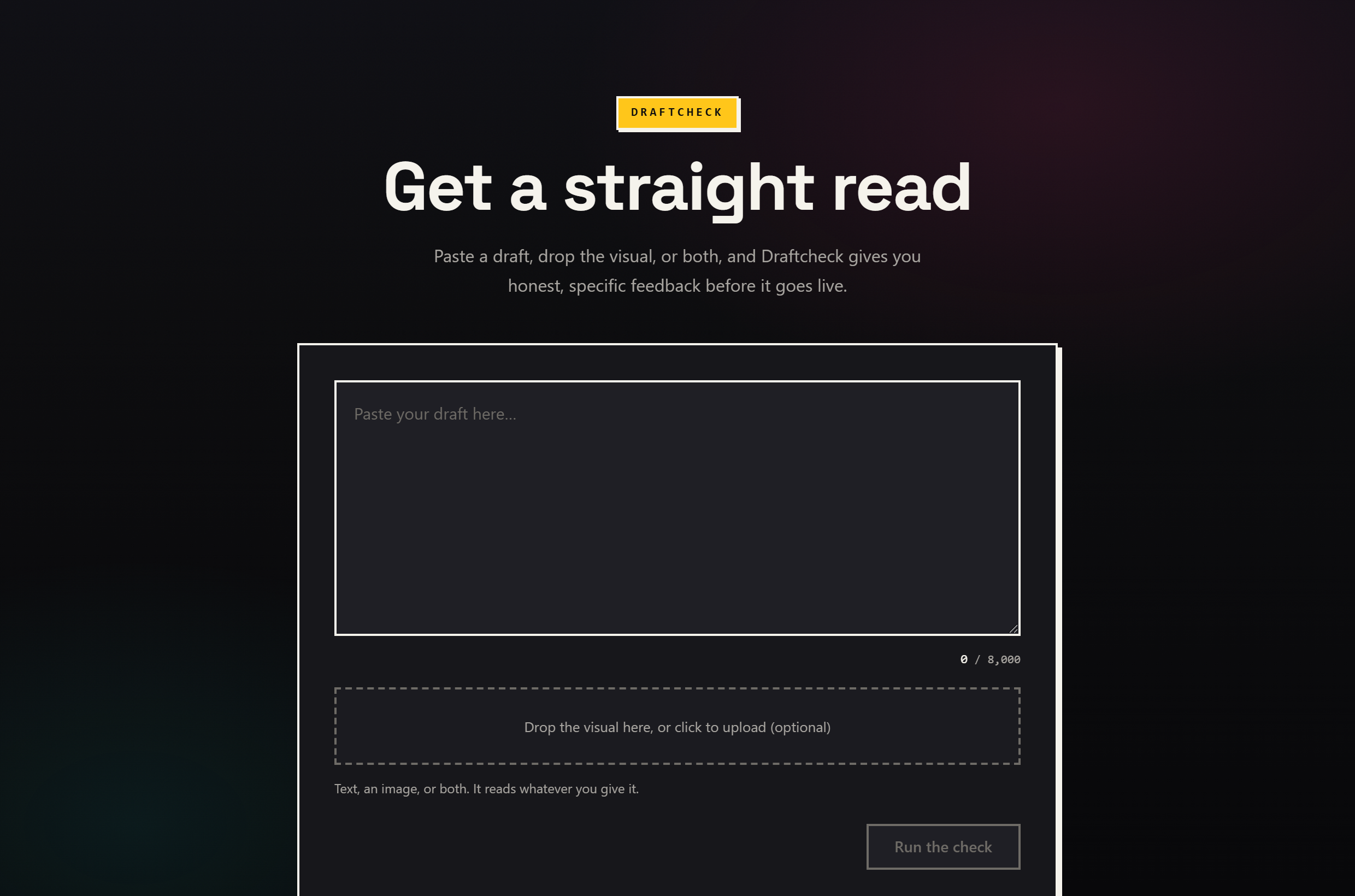
The whole page is one box. Paste the draft, optionally drop the image, hit run. The line under it is the important part: this is a self-check before you post, not my official review.
The part worth writing about isn't that it works. It's what I had to do to make it sound like me instead of like every other AI writing checker.
Why a generic AI content review tool was never going to cut it
The obvious move is to grab an off-the-shelf "AI content detector" and point it at the drafts. I didn't, for one reason: those tools review grammar and score a probability, and the thing I actually care about isn't grammar. Half the drafts that get sent back are clean English. The problem is that a machine could have written them.
That's a taste call, not a rules call. When I review a member's post by hand, I'm not checking whether the sentences are correct. I'm checking whether anyone other than this person could have written them. If the answer is yes, it goes back, no matter how polished it is.
You can't buy that. So instead of renting a checker, I sat down and encoded my own reviewing taste. I pulled 95 real reactions I'd written across 16 old feedback files, the actual notes I'd left members over months, and built the tool's standard out of those. Every rule in it traces back to something I really said to a real person, not an AI's theory of good writing. It grades against the exact bar my hand-written reviews use, because it's made of them.
The one rule the whole thing runs on
If Draftcheck has a spine, it's this: quote the person back, don't lecture them. Point at their own line and react to it. The moment a tool starts explaining "AI writing theory" at you, it's useless, because you can't apply theory to your next sentence. You can only look at the line you wrote and see what's wrong with it.
The test it applies to each line is the same one I use in my head: if you can picture ChatGPT writing the sentence, flag it. The contrast flip, the punchy one-liner, the tidy list of three. None of those are wrong on their own. Good writers use them constantly. The trouble is they're the exact patterns a model reaches for by default, so a whole post built out of them reads anonymous. The verdict is never "this is bad." It's "a machine could have written this, and you're the one thing it can't copy."
And the inverse is the fix, which the tool hands you as well: the second you say what you actually saw, no one else can write that sentence. That's the note it keeps pushing members toward. Less performing, more of the specific thing only you were there for.
It also knows what it's not allowed to touch. It reviews the writing, not the facts. It won't tell you your CEO's name is wrong or your number is off, because it can't know that and I'd rather it stay quiet than confidently invent a correction. When it isn't sure something is real, it says nothing.
It reads the picture, not just the text
A lot of the work in the cohort is visual, things like infographics, thread headers, and meme edits. So Draftcheck takes an image alongside the text and actually looks at it, through a separate vision pass before the writing review runs. The read on the visual gets folded into the same feedback, so if your graphic is doing the thing your caption is also doing, it'll say so.
The rule there is the same as everywhere else in the tool: if it can't see the image clearly, it tells you it couldn't assess the visual. It never pretends to have looked. I'd rather it admit a blind spot than make one up, because a made-up note about your artwork is worse than no note at all.
The tool isn't allowed to sound like a bot
Here's the part I'm most proud of, and it's a little funny. A tool that flags AI writing patterns cannot itself write in AI writing patterns, or the whole thing is a joke. So it's forbidden from committing the tells it catches. No em-dashes in its own feedback, no tidy three-item lists, no "not this but that." It writes in contractions, at a reading level most of my members can actually parse, because a lot of them aren't native English speakers.
It also never stamps a verdict. It won't tell you you're rejected or approved, because it isn't the review. Even on a weak draft the harshest it gets is telling you these patterns tend to show up in work that gets sent back, so give it a real pass first. And when a draft is genuinely good, it says so and stops. It doesn't manufacture a problem list to look useful, which is the fastest way I know to make a member stop trusting a tool.
Small proof this all holds: this article had to pass its own tool before I published it.
Draftcheck is a self-check before the human review
The most important line on the page is the one that says what Draftcheck isn't. It's not my official review. It isn't tied to any submission. You can run drafts on it you never post, and it never approves or blocks anything.
That's on purpose. It sits in front of the human review, not in place of it. Self-check on your own, tighten the draft, post it, and then it comes to me by hand like it always did. I still read everything. The tool just means fewer rushed drafts reach me, and members get a real read at 3am in a timezone I'm asleep in, without waiting on one person.
In its first three weeks live, members ran close to 500 drafts through it, a good chunk of them with an image attached. Plenty of those got the honest "this is genuinely good, go post it" and never turned into a fix. That's the read I want them to have before they commit a post, not after I send it back.
This is the second AI tool I've built for this cohort. The first was an assistant that answers members' questions about their own standing so I don't have to. Same instinct behind both: when a community outgrows what one person can do by hand, build the tool instead of renting one and protect the part that actually keeps a community alive.
If you're running a community or a product that's hit the wall of one person's attention, that's the kind of thing I build. Book a call and tell me what's not scaling.
Frequently asked questions
What does an AI content review tool actually check?
Draftcheck checks taste, not grammar. It asks the one question I ask by hand: could anyone else have written this, or could a machine? It flags the contrast flip, the punchy one-liner, the tidy list of three, the patterns a model reaches for by default, and pushes you toward the specific thing only you saw.
How is this different from an AI content detector?
Detectors score a probability and check grammar. Half the drafts sent back are clean English written by a person who sounds like a machine. I built Draftcheck from 95 of my own real reviews across 16 feedback files, so it grades against my actual bar, quoting your own line back instead of lecturing writing theory.
Can an AI tool give feedback in a specific person's voice?
Yes, if you build the standard out of that person's real work. Every rule in Draftcheck traces to something I actually told a member. It's even forbidden from using the tells it catches: no em-dashes, no tidy triples, no "not this but that." In its first three weeks, members ran close to 500 drafts through it.